Before You Buy Collagen for Smoother Skin, Read This
Before buying another collagen powder, look at the science. Discover what independent studies say about collagen supplements and how to protect your skin naturally.


Collagen is everywhere: powders, protein bars, ice creams, topical creams… last year, I even visited a viral “beauty café” in Paris where you could sip your collagen smoothie followed by a 10 min session of LED mask
treatment. A very clever marketing concept, I have to say!
Before I dive deeper into my current thoughts about collagen supplementation, let’s talk about what collagen is, and what are the promises of supplementing it that have made it so popular in recent years?
Collagen is the most abundant protein in our bodies. It is mainly made out of three amino acids: proline, hydroxyproline and glycine. It provides structural support to our skin (imagine it as a scaffolding), hair, nails and also joints. There are many different types of collagen, each being used for different purposes in our bodies. For example, our skin is primarily made out of Type I and III collagen.
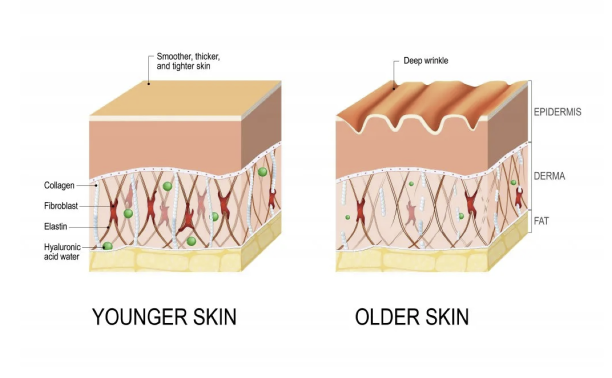
A cross-sectional comparison of younger skin (left) and older skin (right) across the epidermis, dermis, and fat layers. As skin ages, a decline in collagen, elastin, fibroblasts, and hyaluronic acid weakens structural support, leading to surface thinning and deep wrinkles.
Younger skin has dense and organised collagen fibres giving the skin firm support while older skin has sparse and fragmented collagen fibres, so the skin loses structure and wrinkles form.
When we are babies we naturally produce and renew collagen very quickly, which is one of the reasons why baby skin is so soft. Over time, oxidative stress, inflammation, a high-sugar diet, chronic stress and, most importantly, UV light start to break that existing collagen down. At the same time, new collagen production slows down, and what we make isn’t as high-quality as it used to be. It has been found that we start to gradually lose about 1% of collagen each year from our mid-20s.[1]
So, in theory it makes sense that when you ingest collagen, you’ll have more of it, and get all the promised benefits: smoother, glowing skin, and stronger hair and nails, Sounds amazing, right? However, what is the actual evidence?
The reason why so far, I strongly believed collagen supplementation could improve my skin was that there were multiple systematic reviews and meta-analyses, which were confirming that long term oral collagen supplementation does improve skin hydration and elasticity.[2][3]
What prompted me to look deeper into this topic was reading this book Make Me Well by Xand van Tulleken. His arguments against collagen hype made sense and as he puts it – marketing has turned a waste (which collagen essentially is – a waste product from the animal and fish industry) into gold. Essentially, he is saying that most of the studies that are conducted about collagen efficacy are funded by the industry, and there is no reliable data that shows that it actually improves wrinkles.
When I did a bit more research on this on my own after reading this book, I found this systematic review conducted in 2025. Initially, it also showed overall positive results, but afterwards when they performed a subgroup analysis by funding source and study quality, the data shifted dramatically – the independent high-quality trials revealed no significant beneficial effect.[4] Funding is known to distort the actual results of the studies. This is kind of like saying that a study found out that drinking one diet coke per day helps you to lose weight while the study was actually funded by Coca-Cola itself.
I personally have tried different collagen brands and honestly, I never noticed any significant improvements either. Maybe at best, I saw that my nails got stronger when I was taking marine collagen. Interestingly, the book mentions one collagen trial that initially seemed well designed and showed especially impressive results with marine collagen. However, the author later revealed that it was run by a contract research company whose website openly claims it can design trials that help enhance its clients’ marketing claims. In conclusion, what do I think about collagen supplementation at the end?
I think that if you are really into wellness and have some extra budget to spend on supplements, then why not to try it, but make sure to take it consistently at least 8 weeks and min 10g per day. It is not harmful to you, especially if it is from a high-quality source, and some studies still suggest (even if most of them are industry funded) that there could be some beneficial effect on skin. But is it a magic cure? – definitely not. So, you are probably better off investing in basics first.
The basics of protecting your existing collagen and naturally stimulating collagen production:
- Eat lots of Vitamin C rich foods. Vitamin C is an essential co-factor of collagen synthesis). Think of bell peppers, broccoli, kiwis, citrus fruits – these are especially rich in Vitamin C, but you can also try supplementing with it.
- Make sure to also get enough Zinc and Copper. Other important cofactors, but are not mentioned so often. Try adding pumpkin seeds, chia seeds, sunflowers seeds, beef, black beans, kidney beans, and seafood in your diet.
- Eat an adequate amount of protein. If protein intake is low, your body doesn’t have enough building blocks to make new collagen.
- Eat a lower sugar diet. High glycemic index foods and big glucose spikes age you faster, because of AGE’s (advanced glycation end products). Excess glucose in your bloodstream basically “caramelises” your collagen fibres making them sticky and brittle.
- Sleep. It’s called beauty sleep for a reason.
- Don’t smoke. It is pretty well-known that it starves your skin of oxygen and nutrients.
- Cut down on alcohol. It creates inflammation, is high in sugars and worsens your sleep.
- Reduce your stress. I would say, probably one of the biggest factors of aging. Stress actually worsens your insulin sensitivity, which then makes the AGE process more likely to happen. Also, excess cortisol that is being produced more when you are in a high stress state, breaks down collagen.
- Protect your skin from the UV light. One of the most evidence-based things you can do for your skin health, because excess UV light causes photoaging. So, make sure to wear a good-quality SPF and don’t go crazy with tanning.
References:
1. https://pmc.ncbi.nlm.nih.gov/articles/PMC12968778/
2. https://pmc.ncbi.nlm.nih.gov/articles/PMC10180699/
3. https://pmc.ncbi.nlm.nih.gov/articles/PMC12968778/
4. https://www.amjmed.com/article/S0002-9343(25)00283-9/abstract